Course Lesson 2 of 15
- 01 Revise for CSEC
- 02 Plan CAPE from the syllabus
- 03 Class tests and CSEC grades
- 04 Check an AI answer
- 05 What not to paste
- 06 Write a notice
- 07 When the internet drops
- 08 A marks book in Python
- 09 What you do not give a digital ID
- 10 A voice note that is not your relative
- 11 AI on a school laptop
- 12 Do not let an assistant pay
- 13 Python for Caribbean students
- 14 Study techniques
- 15 AI for curious adults
How to Turn a CAPE Syllabus into a Weekly Plan
Copy each CAPE syllabus objective into a list and attach one question you must answer from memory. That list is the weekly plan.
A unit title such as “Module 2” is not a plan. The syllabus already broke the unit into objectives. Those lines are the work.
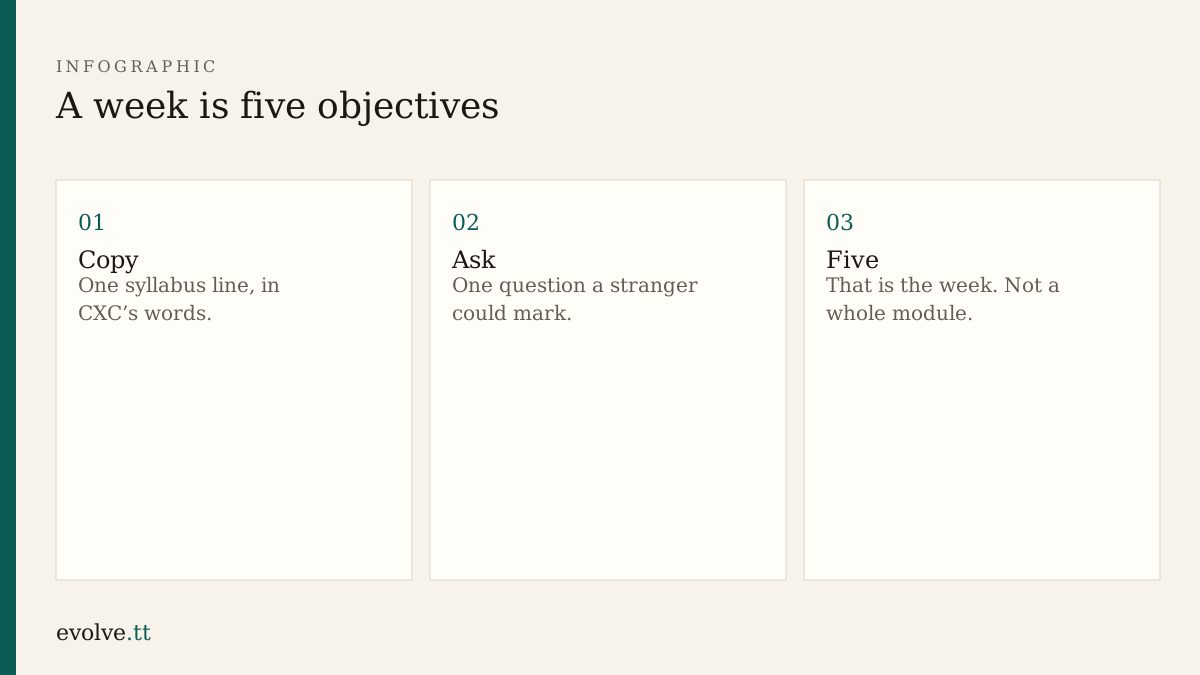
-
Copy the syllabus line
Keep CXC's wording. Do not merge lines.
-
Attach one question
Something a stranger could mark.
-
Answer five this week
Review earlier lines before you add a new one.
Build the list once
Section titled “Build the list once”- Get the current syllabus for your subject and unit from your teacher or from CXC. Check the year. An old photocopy can omit an objective you will be examined on.
- Type or write every specific objective as its own line. Keep the wording. Do not merge three lines into “learn the topic”.
- Next to each line, write one question a stranger could mark. “Explain…” or “Calculate…” is a question. “Revise photosynthesis” is not.
- Stop. You now have the course. The textbook is where you go when you cannot answer a line, not where the week starts.
This is the same idea as the retrieval practice in the study techniques course, pointed at the document CXC actually uses.
What one week is
Section titled “What one week is”Five objectives. Not a module.
| Day | Work |
|---|---|
| 1 | Answer objective 1 from memory. Look up only what you missed. |
| 2 | Objective 2, then answer objective 1 again in one minute. |
| 3 | Objective 3, then the day-3 review of 1 and 2. |
| 4 | Objective 4. |
| 5 | Objective 5, then a short paper question that uses any of the five. |
If an objective takes the whole evening, that is the week shrinking, not a reason to skip the review. Five honest lines beat a highlighted chapter.
One row, written out
Section titled “One row, written out”This row is a sample of the shape. It is not a line from a live CAPE syllabus. Do not revise it. Copy the shape onto CXC’s words for your subject and unit.
Syllabus line: “State one advantage and one limitation of a method.”
Question a stranger could mark: “State one advantage and one limitation of sitting a past paper under timed conditions.”
That is one row. A week is five of those, using the real syllabus. If your copy of the syllabus is not on the phone, save it the next time you have Wi-Fi. When the internet drops is that window. Do not type objectives from memory and hope they match.
When the list is wrong
Section titled “When the list is wrong”If you cannot turn an objective into a question, you do not yet know what it is asking. Ask your teacher before you invent a task. Do not open a chat and ask it to plan the week before you have written one row yourself. If the tool always answers first, the list is the tool’s, and you will not know which line is wrong. Do not replace the syllabus line with a YouTube title.
Past papers still matter. Use them the way the CSEC revision guide describes: one timed piece, then mark it. The syllabus list tells you what to practise. The paper tells you whether you can do it in time.
Discussion
View all discussions on GitHub