Course Lesson 4 of 15
- 01 Revise for CSEC
- 02 Plan CAPE from the syllabus
- 03 Class tests and CSEC grades
- 04 Check an AI answer
- 05 What not to paste
- 06 Write a notice
- 07 When the internet drops
- 08 A marks book in Python
- 09 What you do not give a digital ID
- 10 A voice note that is not your relative
- 11 AI on a school laptop
- 12 Do not let an assistant pay
- 13 Python for Caribbean students
- 14 Study techniques
- 15 AI for curious adults
How to Check an AI Answer Before You Trust It
Ask for the source, open that source, and check the claim yourself. Asking “Are you sure?” is not a check.
The AI course for curious adults gets you talking to ChatGPT. This lesson is the habit that keeps that conversation from becoming a rumour.
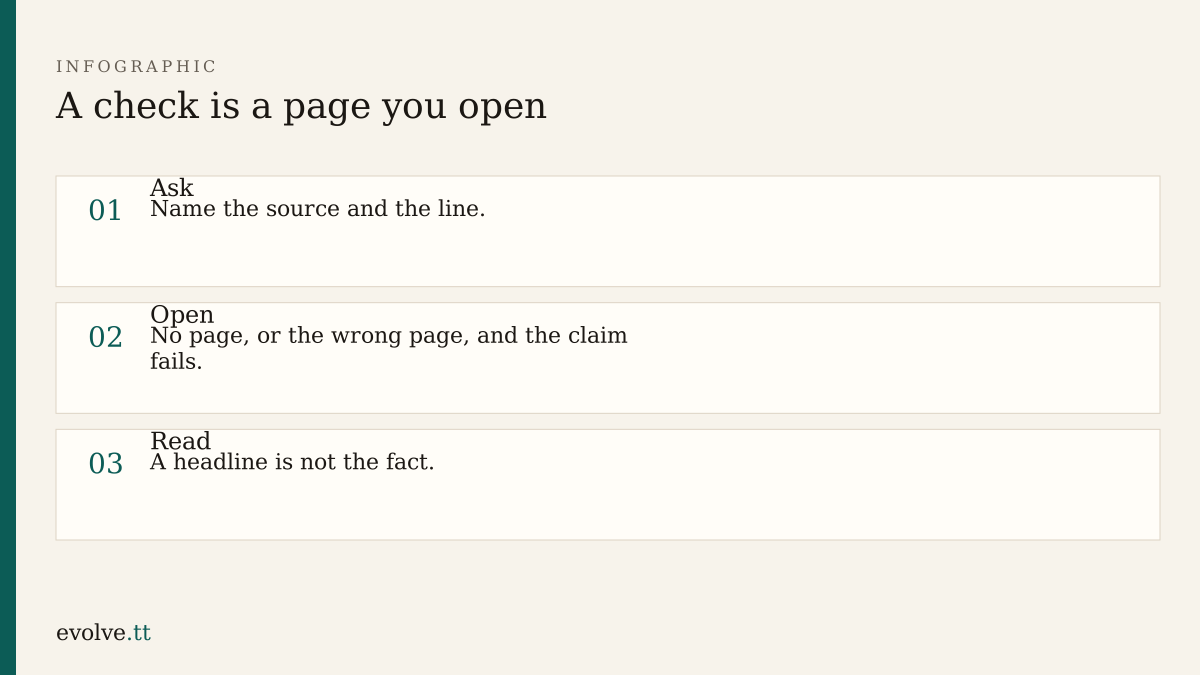
-
Ask for the source
The page, and the line you should read.
-
Open it
No link, or the page does not say it, and the claim has failed.
-
Read the line
A headline is not the fact. Dates and prices slip here.
The three-step check
Section titled “The three-step check”- Ask one follow-up: “What is the source for that, and what is the exact line I should read?”
- Open the link. If there is no link, or the page does not contain the claim, the answer has failed.
- Read the line yourself. A matching headline is not enough. Prices, dates, ages, and grades are where these tools slip.
Stop there. Do not ask a second chatbot to vote. Two fluent answers can share one invented number.
One check, written out
Section titled “One check, written out”Claim from a chat: “50 percent is a CSEC pass.”
- Ask for the source and the exact line you should read.
- A blog, or no page at all, is not the organisation that owns the grade. The tool may offer either. Both fail this step.
- Open CXC’s own description of CSEC grades, or ask your teacher to show it to you. What you are looking for is grades, not a percentage. Grades I, II, and III are the grades treated as passes. The claim does not survive that page.
The longer explanation, including what to say to a parent, is a class test is not a CSEC grade. Do not let the chatbot supply a conversion chart. There is not a fixed one.
What a source is
Section titled “What a source is”A source is a page from the organisation that owns the fact.
| Claim | Source that counts |
|---|---|
| A CSEC grade | CXC, or your teacher reading CXC’s scale |
| A chatbot’s price | That company’s own pricing page, on the day you look |
| A driving age | The licensing authority in that country |
| A medicine dose | A doctor or a pharmacist, not a chat |
A blog that repeats the claim is not a source. This site is not a source for a price. The day-job essay tells you to check the vendor’s page before you pay. That is the same rule.
What you can trust without a link
Section titled “What you can trust without a link”Use the tool freely for work that is yours:
- Rewriting a sentence you wrote.
- A list of ideas for a lesson you already understand.
- A draft notice, which you will edit using the notice lesson.
If a name, a phone number, or a date appears that you did not provide, delete it. The tool filled a gap. Gaps are where inventions live.
A ten-minute practice
Section titled “A ten-minute practice”Take one answer from a chat this week. Pick one sentence that sounds like a fact. Run the three-step check. Write down whether the source existed. That single note is the lesson.
Do not paste account numbers or anyone’s private details while you practise. What never to paste is the other half of this course.
A voice that sounds like family is not a source either. If the note asks for money, call back on the number you already had.
Discussion
View all discussions on GitHub