Thinking
Academic Work Without Handing In Sentences You Did Not Write
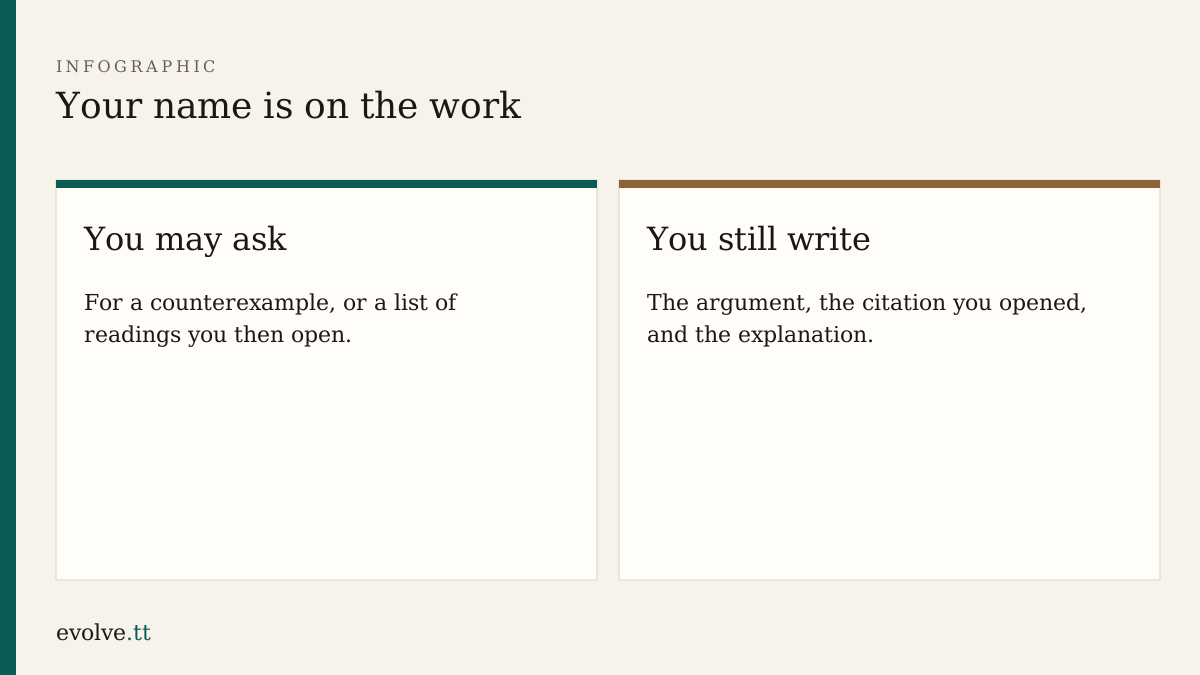
You may ask for a counterexample or a reading list you then open. You may not submit prose you did not write, or a citation you did not open.
Your name on the work means you can explain it. That is the whole ethic. The rest is how not to fool yourself about whose sentences they are.
-
Ask for pressure
A counterexample, or whether your sentence is clear.
-
Open what it names
A reading you have not opened is not a citation.
-
Write the work
The argument is yours. So is the explanation.
The rule is not this page
Section titled “The rule is not this page”This site will not invent a policy for the University of the West Indies, for CAPE, for CSEC, or for a school-based assessment. Those rules are published by the body that assesses you, or they are the instruction your teacher was given. Read that. If a chatbot states a percentage of “how much AI is allowed”, treat it as unchecked. Open the source, or ask the person who will mark the work.
What you may ask
Section titled “What you may ask”- A counterexample to a paragraph you wrote. You decide whether it lands.
- A list of readings. You then open them. The list is not a bibliography.
- Whether a sentence you wrote is clear. The clearer sentence, if you keep it, is still one you can say aloud.
What you still write
Section titled “What you still write”The argument. The paragraph a marker will grade. The citation, after you have seen the page. The explanation, with the chat closed.
Do not paste another student’s work, a marked script, or a child’s record in order to “improve” it. What never to paste applies in a faculty office the same way it applies anywhere else. A teacher formatting a handout they already understand is a different task, and it has its own page.
If you cannot tell a marker which sentences you wrote, do not hand the work in.
Discussion
View all discussions on GitHub